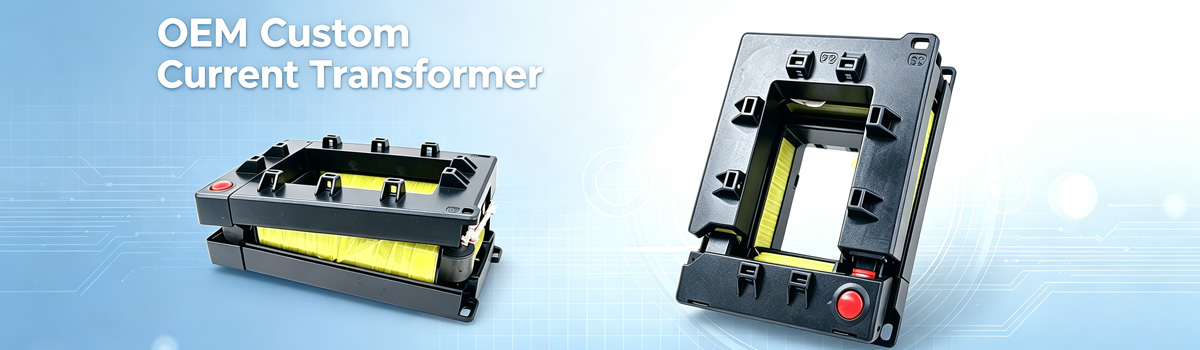
OEM Custom Current Transformer: What Information Should You Provide Suppliers
Oct 07, 2026
If your standard off-the-shelf current transformers cannot fit your panel design, metering or protection requirements, custom OEM CTs are often the practical solution.
Complete specs request helps to will saiving time &cost. This article walks through exactly what details your CT supplier needs from you.
1. Electrical Specifications (The Most Critical Part)
This set of parameters defines the core performance of your custom CT. Missing any of these can result in a product that fails your testing.
Primary & secondary current ratio: For example, 200A/5A or 10A/4mA. Confirm if you need AC or DC capable models.
Accuracy class: Common options include 0.1, 0.2, 0.5, 1.0 for metering; 5P or 10P for relay protection. Make it clear whether high precision is required.
Rated burden / output load: State the VA burden or resistance load the CT needs to drive. This directly impacts core design and saturation performance.
Rated voltage and frequency: Usually 0.66kV, 50Hz / 60Hz. Specify if system works under special frequency ranges.
Saturation requirement: For protection CTs, define the rated accuracy limit factor (ALF). Metering CTs need anti-saturation performance under normal operating current.
Phase error & current error limits: Required if you have strict energy metering standards.
Tips: Do not only state the primary current. If your output signal goes to a PLC or meter, tell the supplier what device the CT connects to. It helps them recommend the proper secondary output format.
2. Mechanical & Size Requirements
CT dimensions are one of the most common reasons custom samples fail on-site installation.
Window inner diameter / opening size: please confirm the hole size for cables or busbars of solid-core toroidal CT, or split-core clamp-on CT .
Overall outer dimensions: Height, width, depth. Especially important for compact cabinet installations.
Mounting method: PCB mount, bracket fixing, through-hole mounting. If with fixed footprint requirements,mounting hole spacing request to be provided.
Cable lead details: Wire length, wire gauge, wire colour, connector type (terminal block, JST connector, bare ends). Specify if leads exit from a particular side of the CT housing.
Housing material and protection grade: Epoxy resin encapsulation, plastic shell, IP rating such as IP54, IP65 for harsh environments.
3. Working Environment Conditions
T application environment decides material selection and long-term stability. Suppliers need to know:
Operating temperature range: Indoor cabinet, outdoor, high-temperature or low-temperature cold storage.
Installation location: Power distribution cabinet, solar inverter, EV charger, energy monitoring device.
Humidity, vibration, dust or chemical corrosion risks.
Expected service life and insulation requirements.
4. Custom Housing & Brand Requirements (OEM Specific)
This section covers your branding and custom appearance needs:
Custom logo printing: Brand name, model number, marking content, printing position.
Custom model code: Your internal part number to be printed on the product.
Housing colour: Standard black, grey, blue or custom colour.
Custom packaging: Neutral packing or branded boxes, label design requirements.
5. Order & Certification Information
These details help suppliers quote pricing and lead time accurately:
Estimated annual quantity, minimum order quantity for the first batch.
Target unit price range if you have budget limits.
Required certifications: CE, RoHS, IEC, UL etc.
Sample requirement: Do you need pre-production samples before mass production? State sample quantity.
Delivery term and target lead time.
6. Common Mistakes When Requesting OEM CT
1. Only send current ratio without accuracy and burden requirements → The CT may not meet your measurement precision.
2. Ignore overall dimension, only confirm window size → The finished CT cannot fit inside your cabinet.
3. Fail to mention special environment → The epoxy or plastic shell may degrade quickly in high heat.
4. Unclear secondary wire requirements → Wires too short, wrong connector, reversed wiring.
5. Forget certification requirements → Product cannot pass local inspection for your market.
Conclusion
Custom OEM current transformers require clear communication between buyers and manufacturers. When you provide complete electrical, mechanical, environmental and branding information at the start, your supplier can deliver accurate quotations and correct samples faster. This avoids costly rework and keeps your project schedule on track.
If you have dimension drawings, it is always best to attach them together with your specification list. Drawings eliminate most ambiguous descriptions and reduce misunderstanding between both sides.
Quick View