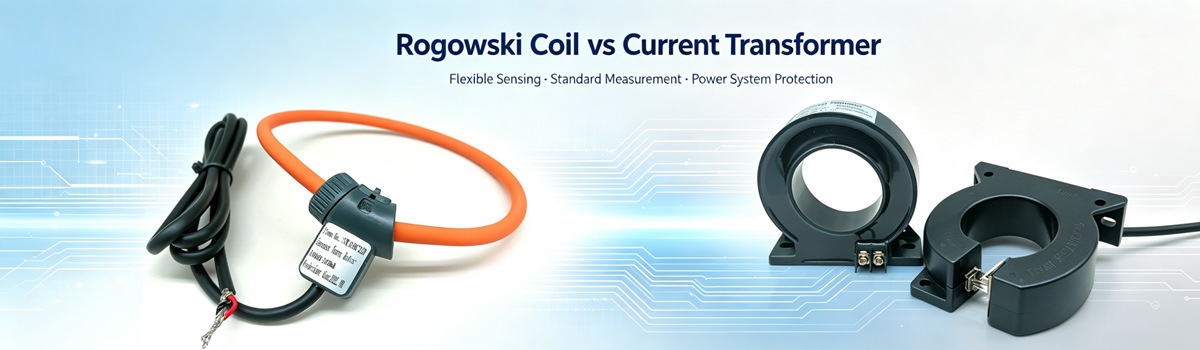
Rogowski Coil vs Current Transformer: Which Is Better for Current Measurement?
Sep 16, 2026
Instruction:
Compare Rogowski coils and traditional current transformers on accuracy, bandwidth, installation, cost, and safety. Learn which technology fits metering, protection, and high-current monitoring.
Rogowski coil and current transformer are both measure current, but work on different principles and serve very different application scenarios.
A current transformer (CT) steps down high primary current to a standard secondary current, typically 1A or 5A, which suited for stable power frequency measurement, energy billing, and relay protection. A Rogowski coil is an air-cored current sensor that outputs a voltage proportional to the rate of change of current, requiring integration to reconstruct the original current waveform.
The difference directly affects installation difficulty, measurement accuracy, frequency response, safety design, and overall system cost. Today we breaks down their advantages, limitations, and typical use cases to help you make a more informed decision.
1. Working Principle
Key difference:
CT is essentially a current-to-current transformer.
Rogowski coil is a current-to-voltage sensor that requires additional signal conditioning.
A current transformer operates on the basis of electromagnetic induction. The primary current flows through a magnetic core, inducing a proportional current in the secondary winding. The secondary current is then used for measurement, protection, or monitoring. Because of the magnetic core, CTs can provide high accuracy at power frequencies and are compatible with most existing metering and protection equipment.
A Rogowski coil is a flexible, air-cored coil that surrounds the current-carrying conductor. It does not produce a secondary current like a traditional CT. Instead, it outputs a low-level voltage signal that corresponds to the derivative of the primary current. To obtain an accurate current reading, the signal must be processed by an integrator or dedicated electronic unit.
2. Accuracy and Measurement Performance
Traditional current transformers are highly reliable for steady-state power frequency current measurement. They are available in well-defined accuracy classes, such as 0.2S, 0.5S, 1P, 5P, and 10P, making them suitable for both precision metering and protection applications. When properly sized and installed, CTs can maintain consistent accuracy over long periods.
However, CT performance depends heavily on core material, burden matching, and operating current range. If the actual load exceeds the rated burden, or if the primary current becomes too high, the core may saturate, causing waveform distortion and increased measurement error.
Rogowski coils offer excellent linearity and a wide frequency response. They can measure AC current over a broad frequency range and are particularly useful for capturing harmonics, transient currents, and fast-changing waveforms. Because there is no magnetic core, core saturation is generally not a major concern.
That said, Rogowski coils are not inherently accurate for DC measurement, and their overall accuracy depends on coil quality, installation consistency, and the performance of the integrating circuit. For high-precision billing-grade metering, CTs remain the more established choice.
3. Installation and Flexibility
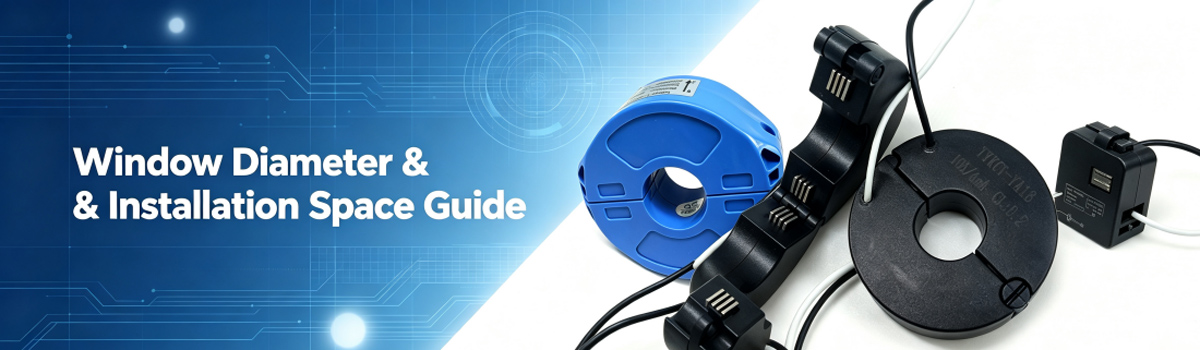
clamp-on, or split-core type design allow them installed around existing busbars or cables without disconnecting the circuit. It is especially valuable in retrofit projects, temporary monitoring, and high-current installations where access is limited.
Traditional CTs are available in solid-core, split-core, and clamp-on versions. Solid-core CTs generally require the conductor to be passed through the aperture during installation, which can be inconvenient in existing systems. Split-core CTs improve installation flexibility, but they still require proper alignment and consistent mechanical closure to maintain rated accuracy.
4. Safety Considerations
Current transformers are generally safe when used correctly, but they require careful handling. A CT secondary circuit must never be opened while the primary side is energized. An open secondary can produce extremely high voltage, which may damage equipment, degrade the core, and create safety risks for personnel.
Rogowski coils do not have this same open-circuit hazard. Since they output a low-level voltage signal rather than a high secondary current, they are generally safer in installation and maintenance. This makes them attractive for online monitoring systems, temporary power quality analysis, and applications where frequent sensor access is required.
However, safety is not only about open-circuit risk. Traditional CTs are still widely trusted in high-voltage substations, protection panels, and metering cubicles because of their proven stability, standardized ratings, and long-term operational history.
5. Typical Applications
Current transformers are the standard choice for:
- Energy metering and billing systems
- Relay protection circuits
- Power distribution panels
- Substation current measurement
- Industrial control and monitoring systems
- Applications requiring 1A or 5A secondary output
Rogowski coils are more suitable for:
- High-current AC measurement
- Power quality analysis
- Harmonic current detection
- Transient current monitoring
- Temporary field testing
- Retrofitted monitoring systems
- Applications requiring flexible, clamp-on installation
If your project needs to comply with metering standards or interface with traditional protection relays, CTs are usually the safer selection. If you need wide frequency response, easy retrofitting, or non-intrusive high-current measurement, Rogowski coils are worth serious consideration.
6. Cost and System Integration
Traditional CTs are generally cost-effective for standard current measurement applications. They are widely available, easy to source, and compatible with most existing meters and protection devices. The main cost factors include current ratio, accuracy class, rated burden, insulation level, and mounting type.
Rogowski coils can be more expensive when the total system cost is considered. The sensor itself may be flexible and convenient, but it often requires additional electronics, such as integrators, signal conditioners, or data acquisition modules. For projects that already use standard 1A or 5A input devices, CTs are usually the simpler integration path.
However, in high-current or difficult-to-install environments, the lower installation labor cost of Rogowski coils can offset the higher component cost. Therefore, engineers should evaluate not only component price but also installation effort, system compatibility, and long-term maintainability.
Final Summary
Rogowski coils and current transformers both serve the purpose of current measurement, but they are designed for different priorities. CTs excel in accuracy, standardization, and compatibility with traditional metering and protection systems. Rogowski coils excel in flexibility, frequency response, and ease of installation.
Choose a current transformer if:
- You need standardized 1A or 5A secondary output
- High-accuracy energy metering is required
- The application involves relay protection
- Compatibility with existing power system equipment is important
- Cost efficiency and proven reliability are top priorities
Choose a Rogowski coil if:
- You need flexible, clamp-on installation
- High-current or wide-frequency measurement is required
- You want to avoid CT open-circuit risks
- The project involves power quality or harmonic analysis
- Retrofit or temporary monitoring is part of the requirement
In practice, there is no universal answer. The best choice depends on your current level, accuracy requirement, installation condition, existing system architecture, and safety strategy. Understanding these pros and cons will help you select the right current sensing technology rather than relying only on component price or technical popularity.
More details, pelase contact us freely.
Quick View