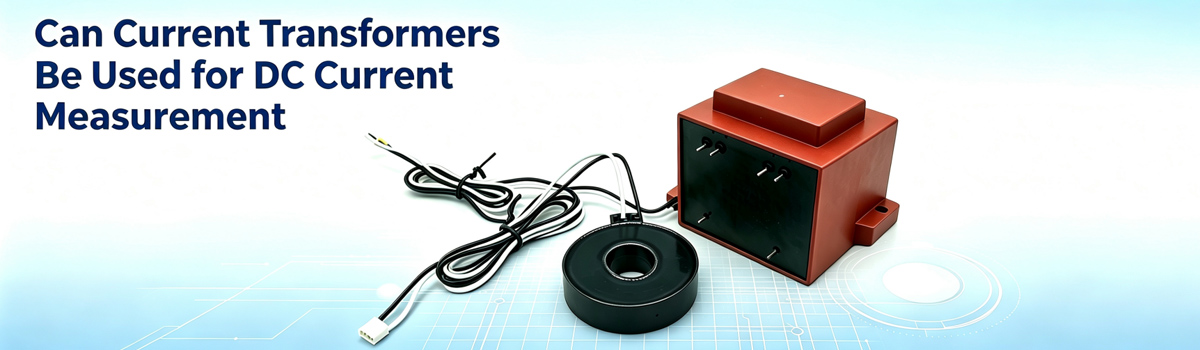
Can Current Transformers Be Used for DC Current Measurement? Key Facts You Should Know
Sep 23, 2026
When working on power‑monitoring, energy‑audit or equipment‑retrofit projects, engineers often raise one practical question: can regular current transformers (CTs) measure DC current?
Many field technicians are familiar with clamp‑on or split‑core current transformers widely used for AC power systems. These devices are cost‑effective, easy to install without cutting cables, and perform reliably for alternating‑current scenarios. But applying them to DC circuits will lead to misleading readings or zero output, and this point is frequently misunderstood.
Why conventional current transformers cannot measure DC?
Traditional current transformers operate based on "electromagnetic induction". They rely on continuously changing magnetic flux generated by alternating current in the primary conductor to induce secondary‑side output.
Direct current produces a static, constant magnetic field in the core. Since there is no flux variation over time, the CT secondary winding cannot generate an induced voltage. For this reason, standard iron‑core CTs, whether solid‑core or split‑open type, do not respond to steady‑state DC.
There is another hidden risk. If a large DC flows through the primary cable, it may cause magnetic core saturation. Once saturation happens, the transformer loses measurement accuracy even for superimposed AC components, which may damage downstream metering hardware.
What options exist for DC current measurement?
If you need to capture DC current values, you have to pick sensing technologies built for static magnetic fields. Below are the most common industrial‑grade solutions:
1. Hall effect DC current sensors
Hall effect sensors detect static magnetic field strength created by DC current. Many are designed as split‑core / clamp‑on structures, keeping the non‑intrusive installation advantage of CTs. They are popular for solar PV systems, battery banks, DC‑charging piles and industrial DC power cabinets.
2. Rogowski coils (Only for AC / pulsed DC)
It is worth clarifying: flexible Rogowski coils you see in many catalogs also work on induction principles. They respond to current change rates. They can measure pulsed or fluctuating DC, but cannot read stable, constant DC. This is a very frequent misapplication on site.
3. Shunt resistors
Shunt resistors offer high‑precision DC measurement. The main downside is galvanic contact: you must break the circuit for wiring. They are widely adopted inside battery BMS and high‑precision test equipment, but less convenient for retrofitting existing live cables.
Mixed‑flow scenario: measuring AC‑DC superimposed current
In real‑world sites such as inverter output, rectifier circuits or aging power equipment, you may encounter current carrying both AC ripple and DC offset.
- Ordinary CT: DC component saturates core, AC reading drifts and becomes unreliable.
- Open‑loop / closed‑loop Hall sensors: capable of measuring total current including DC offset and AC ripple simultaneously.
Quick practical decision checklist
- Measuring pure alternating current? → Standard current transformer works perfectly.
- Measuring steady direct current? → Choose Hall‑effect DC sensor, avoid regular CT.
- Only measuring pulsed / varying DC? → Rogowski coil may fit your requirement.
- Need high‑accuracy lab‑grade DC data? → Consider shunt‑resistor solutions.
To sum up: standard current transformers are designed exclusively for AC current and are not suitable for DC measurement. Trying to deploy them for DC will bring invalid measurements and potential core saturation trouble.
Matching the sensor principle to your actual current type helps you avoid debugging headaches and ensures long‑term reliable data acquisition for energy monitoring, protection and analysis systems.
Quick View